One Prop, Three Scenes: Let an Object Change Its Job
A one prop, three scenes rehearsal exercise helps actors discover how context changes an object’s meaning without buying extra stage dressing.
How can one prop mean three different things without changing the object itself? A one prop, three scenes rehearsal exercise gives performers a simple way to find out: keep an ordinary object constant, change the scene around it, and notice how the audience’s reading shifts. A wooden spoon, scarf, or empty mug can become a useful tool for exploring stagecraft on a shoestring.
What does the exercise reveal about a prop?
A prop’s meaning comes partly from what it is and partly from what people do with it. A mug may suggest comfort when someone warms their hands around it, authority when a character uses it to demand attention, or grief when another person cannot bring themselves to pick it up. The object is unchanged; the relationships and circumstances have changed.
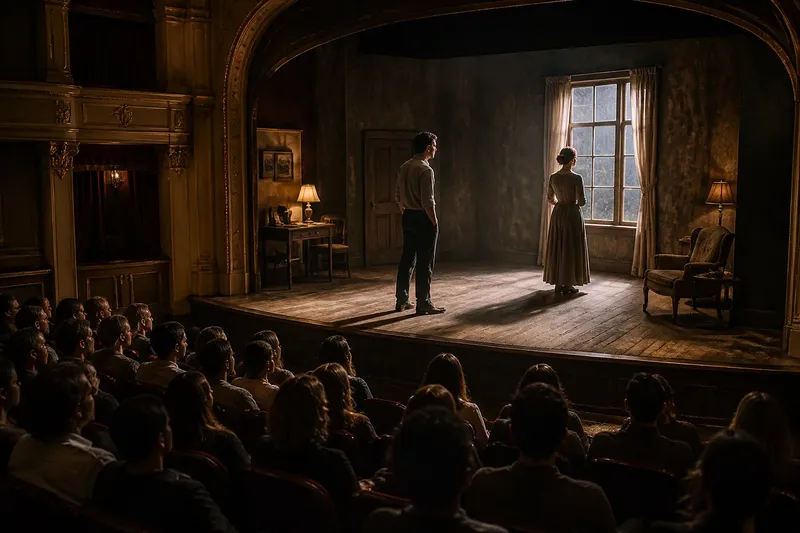
That distinction matters in live theatre. The audience does not see an object in isolation. They watch who handles it, who is allowed to touch it, where it appears, and what happens just before and after it moves. Those choices make an object legible as part of the action rather than as decoration.
The exercise is not a contest to invent the cleverest transformation. A convincing use is often plain: a chair is somewhere to sit, a boundary, or an absent person’s place. The point is to notice how a small physical choice can steer attention and feeling.
What should you choose for the object?
Choose something ordinary, easy to hold, and sturdy enough for repeated rehearsal. A scarf, paperback book, wooden spoon, cloth tote, or empty plastic cup can work. It should be familiar enough that performers know its everyday use, but open-ended enough to support other actions.
Keep the object neutral at first. Avoid items that carry a strong costume, cultural, or plot meaning for your group unless that association is exactly what you want to examine. A toy weapon, for instance, can dominate the exercise before actors have made any choices. A plain scarf offers more room to discover meaning through handling.
Use only one object throughout the three scenes. That constraint makes the changing context easier to see. If you bring in a collection of props, the group may start solving each scene with new objects instead of exploring what the shared object can do.
How do you run the one prop, three scenes exercise?
Set aside a clear rehearsal area, one object, and a small group of performers. The scenes can be improvised or brief passages from a play. For an improvised version, offer a distinct situation for each scene without dictating the object’s use.
- Introduce the object. Let each performer handle it briefly and identify its ordinary properties: weight, texture, sound, and the ways it can be held or moved.
- Set three different circumstances. For example, the first scene might involve a private apology, the second a public contest for authority, and the third a farewell. Choose situations that create different relationships and stakes.
- Play the first scene. Give the performers a short stretch of action, then stop at a moment when the audience can read what the object means in that situation.
- Reset the object and play the next scene. Keep the same physical item, but change the circumstances. Ask performers not to announce its new meaning; let the action establish it.
- Repeat for the third scene. Maintain the object’s identity while allowing its use, location, and importance to change.
- Compare what the audience noticed. Ask observers what they thought the object was doing in each scene, and which action or relationship shaped that interpretation.
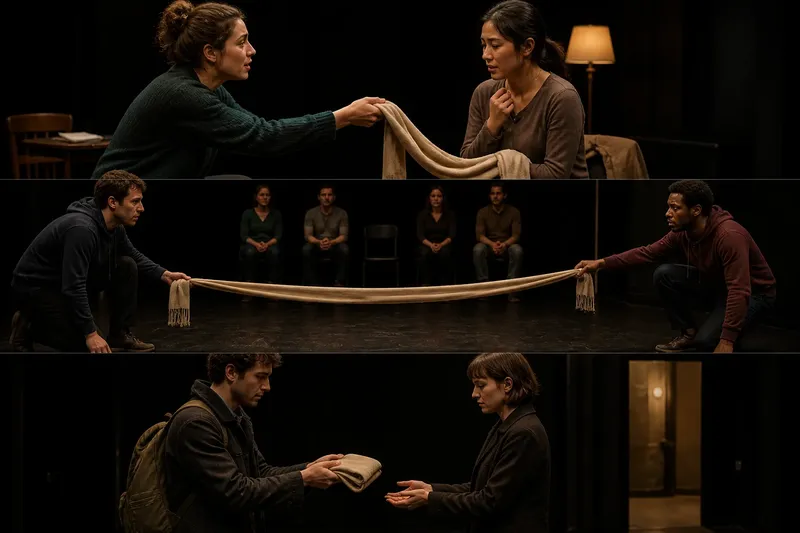
Say a group chooses a plain scarf. In an invented rehearsal situation, the first scene is a private apology: one performer offers the scarf as a gesture of care, and the other hesitates before accepting it. In the second, two characters compete for control of a public space, and one stretches the scarf across the floor as a boundary. In the third, a character preparing to leave folds it carefully and gives it back. The expected observable result is not a single correct interpretation; it is that audience members can describe how the scarf’s function shifted with the relationship and action.
How can you tell whether each scene reads clearly?
Ask observers to describe what they saw before asking what they felt. “She held it between them” is more useful at first than “it seemed sad.” Concrete observations help the performers identify which choices communicated the scene and which remained private intentions.
Look for a clear physical action, a relationship to another character, and a consequence. If a performer waves a book without anyone responding, the object may not yet have a dramatic job. If another character refuses to take it, hides it, or changes their behavior because of it, the audience has something to follow.
Also notice whether the object can be seen from the back of the room. A tiny gesture may feel vivid to the actors and disappear at a distance. Try making the action more distinct rather than simply larger: turning the object outward, holding a pause, or placing it where the other character must acknowledge it can clarify the choice.
What should you do if the object feels forced?
Give the performers a more specific circumstance before asking for a more inventive use. “A tense scene” may not offer enough to act on; “one person needs the other to return something before a door closes” gives them an immediate relationship and obstacle. The object can then enter the scene because someone wants, refuses, or fears something.
If the action still feels arbitrary, remove the object briefly and play the scene without it. Then bring it back only where it changes what a character can do. This quick comparison can show whether the prop contributes to the encounter or merely occupies a hand.
It is not worth spending rehearsal time decorating or modifying the item to make its meaning obvious. In this exercise, the audience should be able to follow the action through performance choices. If a special feature is essential, that may be a useful discovery, but it is not the exercise’s starting point.
What questions help performers and observers?
Does the object need to be realistic?
No. A neutral object can stand for something else if the performers establish that meaning through consistent action. The audience needs a readable relationship, not a perfect imitation of the imagined item.
Can the object change hands between scenes?
Yes, but decide whether the handoff is part of the scene or simply a reset. A deliberate transfer can carry meaning, while an unexplained reset may distract observers from the new circumstances.
Should the audience know the object’s intended meaning?
Not in advance. Ask observers what they understood after each scene, then compare their readings with the performers’ intentions. Differences can reveal where a gesture needs more clarity or where ambiguity is productively alive.
Can you use a scene from a finished play?
Yes, if the object can be explored without changing the passage’s essential action. A short excerpt can help actors consider how blocking and handling contribute to an existing scene, while improvisation gives them more freedom to invent circumstances.
How can the exercise inform a production?
Once the three scenes have been played, choose one moment and repeat it with a different object. Keep the circumstances and relationships steady. The comparison helps performers see whether the original item matters because of its material qualities, because of its established meaning, or because of the way it is handled.
Then return to the scene’s actual staging needs. A rehearsal discovery is not automatically a production choice. Consider sightlines, the pace of the scene, how the object is introduced, and whether its role remains clear when costumes, furniture, and other stage elements are present. Where an item has to function in a particular way, follow the relevant production or manufacturer guidance and local requirements.
A one prop, three scenes exercise works best when it leaves performers with a sharper question, not a fixed answer: what does this object let a character do that they could not do without it? That question can turn a familiar cup or scarf into a precise piece of stage action, while keeping the rehearsal room focused on the people who give it meaning.