When the Curtain Was Not the Main Event
Explore theatre spaces before the proscenium, from thrust stages to arenas, and learn how each layout shapes sightlines, acting choices, and audience attention.
What did audiences see before the proscenium framed the stage? The history of theatre stages includes platforms and playing spaces that brought spectators close to the action, though their designs varied by place and period.
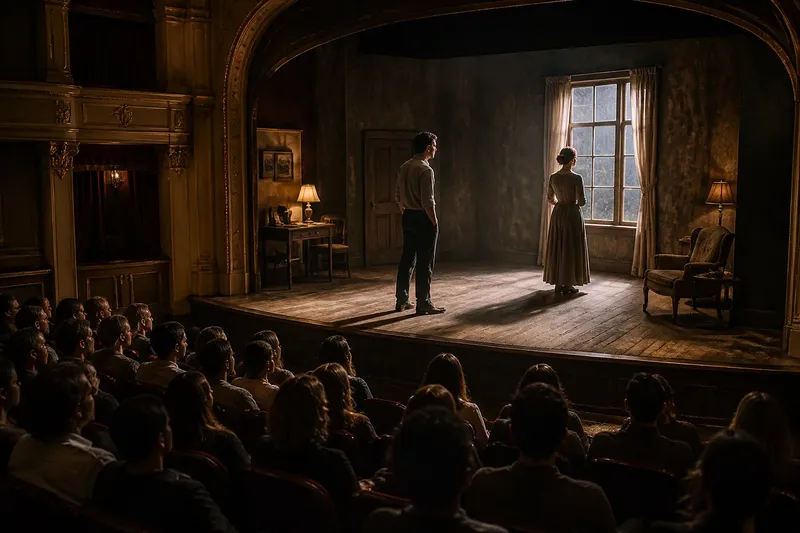
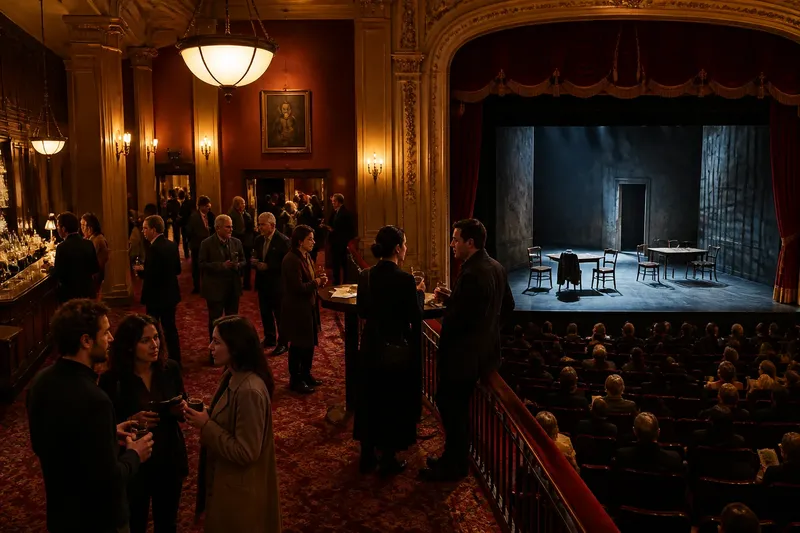
A proscenium arch separates the stage from the auditorium like a picture frame. It offers a strong front, a clear place for scenery, and a shared direction for spectators. Other arrangements loosen that boundary. Performers may face several sides, enter through the audience, or play on a raised platform visible to a surrounding crowd.
These are not merely architectural curiosities. The layout affects how a performer addresses a room, how scenery works, and whether spectators feel they are looking into a composed image or gathering around a shared event. Three arrangements help explain what changes when the curtain is not the main event: the thrust, the arena, and the open platform.
A thrust stage keeps a front while inviting the sides in
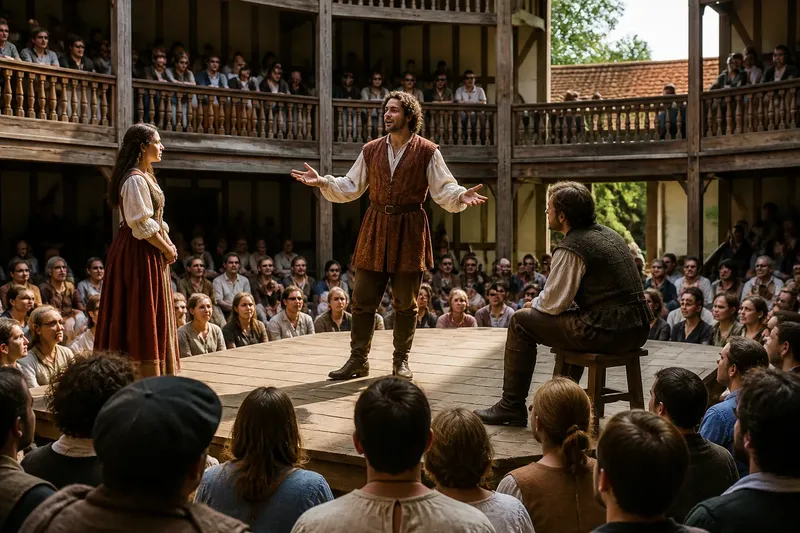
A thrust stage projects into the audience, with spectators seated on three sides. It retains a primary playing direction, but the action is no longer contained behind a single frame. A performer can turn toward one bank of seats and then another; spectators may see fellow audience members across the playing space.
London’s Globe Theatre, built in the late sixteenth century, is a familiar example of an open-air playhouse with a projecting stage surrounded by audience areas on multiple sides. Its arrangement was not identical to every playhouse of the period, and historical venues differed in their details. The example helps clarify the principle: actors performed in a shared space rather than behind a proscenium opening, so action needed to register from different viewpoints.
That arrangement can suit plays built on direct address, social observation, or lively exchanges among characters. A scene may feel public, as if the audience has gathered close to hear a dispute. It can also support intimacy without making the event private: a quiet line takes place within a visible crowd.
The trade-off is that a single picture is harder to compose. If an actor turns away from one section, that section may lose a face or a gesture. Large, flat scenery can block sightlines, and a table arranged for one front-facing audience may hide action from the sides. Designers often favor open objects, flexible furniture, and movement that makes a scene readable from more than one direction.
For an audience member, a thrust stage can make attention feel active. You may choose whether to watch the speaker or notice the listener across the platform. Yet the experience depends on the seat: a gesture that reads clearly from one side may be obscured from another. The arrangement does not make every seat equally revealing; it makes different viewpoints part of the event.
An arena stage puts the audience around the action
In an arena arrangement, spectators sit on all sides of the playing area. This removes the usual front altogether. Performers must continually negotiate orientation, and scenic elements need to preserve views around the room rather than create a single concealed background.
Arena performance can make proximity vivid. A character crossing the space may pass close to one group and then recede from it. A circle of spectators also makes the audience visible to itself, creating the feeling of a gathering. That quality can suit ritual, ceremony, communal storytelling, or a play whose tensions grow more compelling when no one occupies an obviously privileged viewpoint.
It also places real demands on staging. A scene of two people speaking face-to-face cannot remain fixed in one line without presenting someone with their backs. Performers may shift positions, use diagonals, or address different sectors in turn. A central object can be useful, but it should not become a wall of bodies that shuts out half the room.
Because the playing space is exposed, elaborate scenery can be more hindrance than help. A bare floor, a few movable objects, or a change in light may establish a new place more clearly than a structure that blocks sightlines. The audience’s closeness can sharpen small gestures, but it can also make every movement conspicuous. Subtlety needs to be calibrated to the room rather than assumed to work at every distance.
An arena may suit spectators who enjoy watching how a whole room responds, not just following a framed image. It can be less comfortable for someone who strongly prefers a fixed front and a stable view of faces. That is not a judgment about taste; it is a useful distinction when choosing a performance.
An open platform makes the venue part of the stage
Before permanent theatre buildings supplied consistent stages and auditoriums, performers could use temporary platforms in courtyards, public spaces, halls, or other available venues. An open platform might face one main audience area or be approached from several sides. Its defining feature is flexibility: the performance space was set up for the occasion rather than built as a permanent picture frame.
This arrangement suits stories that can make a simple playing area feel specific through speech, costume, entrances, and a few telling objects. A platform in a courtyard does not need to imitate a street corner in detail. Performers can establish the place through what they do and say, while the actual building remains visible around them.
The venue contributes its own conditions. A doorway can become an entrance; a gallery may hold spectators above the action; daylight and weather may shape the atmosphere. Such features can lend a performance character, but they also require adaptation. A line delivered clearly in an enclosed room may be lost outdoors, and a busy venue can compete with the actors.
Temporary settings were not simply primitive versions of later theatres. They offered a different relationship between performance and place. The audience might arrive already familiar with the courtyard or public building, bringing its ordinary associations into the story. A purpose-built theatre can control more of its surroundings; an adapted venue allows those surroundings to remain part of the experience.
For audiences, an open platform can appeal when the character of a particular place matters. It is less suited to someone seeking a carefully enclosed visual world with consistent acoustics and sightlines. Even a modest platform can feel theatrical, but its success depends on how performers and spectators share the available space.
Choose by the kind of attention you enjoy
There is no universally best arrangement. A useful choice begins with the experience you want: a clear front, a close gathering, or a performance that makes its venue visible. If you are deciding between productions, check the seating plan and look at where the stage sits in relation to the audience. A promotional image may show the set but conceal the room’s actual layout.
- Check whether seats face one direction. If most seats point toward a framed stage, choose that production if a composed view matters; if not, compare a layout with more surrounding seats.
- Check whether the stage projects into the audience. If seats flank the platform on two sides as well as the front, consider the thrust for a close but still directional view; otherwise, look for another configuration.
- Check whether seats surround the playing area. If they do, choose the arena if changing viewpoints appeal to you; if you prefer a stable front, select a proscenium or thrust instead.
- Check whether the performance uses an adapted venue. If the plan shows a courtyard, hall, or public space, choose it if the setting itself interests you; otherwise, favor a purpose-built auditorium.
- Check where large scenic pieces sit. If a tall structure occupies the center or sides, ask the box office about obstructed views; if the layout looks open, decide whether its simpler visual world suits you.
- Check whether the map marks restricted or side views. If your likely seat is marked restricted, choose another section if seeing faces clearly matters; if you are comfortable with a partial view, keep that seat in consideration.
Say you are choosing between two productions of a story about a public argument. In this invented situation, the starting point is a seating plan for a proscenium production with a detailed town-square set and a second plan showing a thrust with seats on three sides. You first check whether you want to study a composed image or feel close to a gathering; then you compare the stage shape and whether any seats are marked restricted. If the framed town square is your priority and the plan shows a straightforward front, the proscenium is the better fit; if you want spectators to share the space as witnesses and accept changing views, choose the thrust. The trade-off is a more controlled picture versus a more exposed, communal encounter.
It is not worth trying to infer the entire production from a stage label alone. A thrust can still feel distant if the acting and design keep the audience at a remove, while a proscenium production can create intimacy. The arrangement offers possibilities, not a verdict on what the performance will do.
What should you look for in the seating plan?
How can you tell if a theatre has a thrust stage?
Look for seats shown on three sides of a platform that projects into the auditorium. The seating map may call it a thrust, but the shape is often clear even when the label is not.
Is an arena stage the same as a thrust stage?
No. An arena surrounds the playing area on all sides, while a thrust generally has a main audience area at the front and additional seating along the sides. That difference changes how often performers need to redirect the scene.
Does a proscenium stage always use a curtain?
No. The proscenium describes the frame or opening between stage and auditorium, not a required curtain. A production may use no curtain, or may leave the playing space visible before and after the action.
Can an open-air platform be a theatre?
Yes. A theatre can be a place where performers and spectators gather for a performance, whether or not it is a permanent, enclosed building. An outdoor platform can shape a theatrical event just as strongly as a purpose-built auditorium.
Stage arrangements change the audience’s role
Theatre spaces developed through many local traditions rather than a single sequence of improvements. The proscenium became influential because its frame offered distinct advantages, including control over sightlines and scenic presentation. Thrusts, arenas, and temporary platforms did not disappear as lesser forms; they continued to serve different relationships between actor, audience, and place.
When you read about the history of theatre stages, pay attention to the audience’s position as much as the set. Ask what can be seen, who can see whom, and whether the room encourages spectators to face forward, look across, or gather around. A seating plan is more than a diagram of chairs: it records how a particular performance invites people to watch together.